Lieutenant Mamiya’s letter
The Wind-Up Bird ChronicleLieutenant Mamiya’s letter is the written sequel to a wartime history that Mamiya had begun telling Toru Okada in person. Sent near the end of a year, it completes an account he had previously left unfinished: Mamiya explains that practical constraints and his own emotional unreadiness had kept him from telling everything. Its significance lies both in what it reveals about his survival and captivity and in the act of belated testimony itself.## Arrival and Purpose of the Letter After a day spent close to home, Okada finds a thick letter in his mailbox. He recognizes its writer from the old-fashioned brush handwriting before checking the return address: Lieutenant Mamiya, the only person who writes to him in that distinctive hand. The physical letter brings Mamiya’s distant past into Okada’s present, not as a brief update but as a deliberate continuation of their earlier exchange.
Mamiya opens with an apology for the long silence and explains why he has finally written. He has wanted for months to tell another part of his story, but circumstances repeatedly prevented him from sitting down to do so. Now the year is almost over, and he recognizes that, as an old man, he cannot postpone the task indefinitely. His awareness of time gives the letter its urgency: what could not be said earlier must be entrusted to someone while there is still an opportunity to say it.
The letter refers back to Mamiya’s visit the previous summer, when he delivered Mr. Honda’s memento and told Okada about his time in Mongolia. That earlier account was incomplete by design and by necessity. Mamiya says that telling the entire story then would have taken too long, and that pressing business left insufficient time. More importantly, he was not yet emotionally prepared to recount the rest fully and honestly. The written sequel therefore corrects an omission that was not merely logistical: the missing portion had remained difficult for him to face.### A Sequel to the Mongolia Account Mamiya says that, after leaving Okada, he realized practical considerations should not have prevented him from telling the story through to its end. He now wants to relate everything without concealment. The letter’s structure is consequently retrospective and corrective: it returns to the point where the spoken account stopped, identifies why it stopped there, and makes completeness an explicit purpose of the new telling.
That purpose changes the meaning of the earlier visit. Mamiya had already placed his wartime experience before Okada, but the first telling had not exhausted what he could disclose. The letter does not treat reticence as a simple lack of information; Mamiya connects it to his inability, at that time, to speak with full emotional honesty. Writing later allows him to reopen the history and give it the ending he had withheld.
Survival, Injury, and the Return
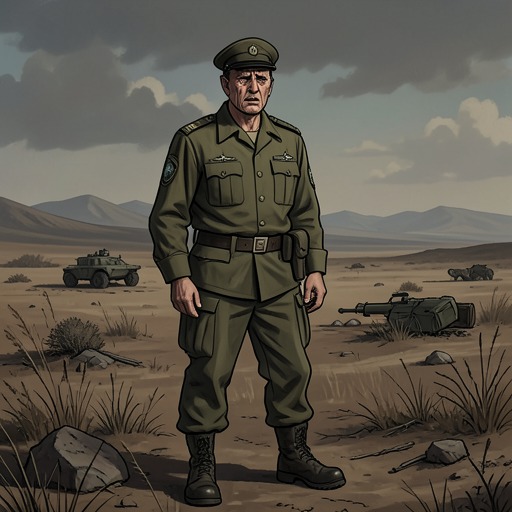
The sequel moves from the border mission to the battle that determined Mamiya’s fate. On August 13, 1945, during fighting on the outskirts of Hailar, he was struck by machine-gun fire and lost his left hand beneath a Soviet tank. Unconscious, he was taken to a Soviet military hospital in Chita, where surgeons saved his life. His survival contradicted his own intention: although attached to the Kwantung Army’s Military Survey Corps in Hsin-ching and slated to withdraw when the Soviet Union entered the war, he had transferred himself to the Hailar unit, determined to die in an attack on a tank. He recalls that Mr. Honda had foretold on the banks of the Khalkha River that he would not die easily. The men under Mamiya’s command, he believes, were killed in the attack, which he describes as a futile use of portable mines against a much larger tank.
Mamiya attributes the Soviet hospital’s care partly to his speaking Russian while delirious. He had studied the language while working in the Hsin-ching General Staff Office, where spare time allowed him to improve his Russian through conversation with Russian waitresses. This detail gives the letter’s account of survival an unexpected practical cause: a skill cultivated far from the battlefield may have helped keep him alive after it.
From Staff Work to Captivity
The letter places Mamiya’s wartime ordeal against the logistical and political conditions that shaped the border mission. He had been appointed escort commander not because he was an experienced combat officer—he had none—but because his surveying work concerned the western border of Manchukuo near the Khalkha River. The mission also let him gather more precise topographical information. Existing maps of the Hulunbuir Steppe were crude, while the Kwantung Army had reasons to leave the border undefined: a unilateral map might provoke an international incident, and Japan lacked the forces to risk a major confrontation with the Soviet Union while committed to the war in China. Yet the uncertainty had a practical cost. If conflict came, the army would need combat maps detailed enough to plan camps, artillery positions, marches, water supplies, and horse feed. Mamiya’s account thus connects an apparently narrow surveying assignment to the larger problem of fighting a war without reliable knowledge of the terrain.
That problem was starkly embodied in the landscape. After five days of preparation, the party traveled by train from Hsin-ching to Hailar, then by truck past the Khandur-byo Lamaist temple to a Manchukuo Army observation post near the river, a journey of roughly two hundred miles. The steppe offered no landmarks by which Mamiya could check his map; he could only estimate their position from the time spent driving. In the letter, this account of disorientation also recalls how the vast, nearly unchanging landscape seemed to loosen a person’s sense of self. The physical difficulty of mapping the border becomes an image of the difficulty of holding on to a stable perspective within an immense and indifferent world.
Mamiya’s account also describes the military system’s attention to supplies beyond the border maps. A book on Manchukuo logistics, which Okada later reads among the volumes Cinnamon had gathered for him, records that the Japanese army had considered a possible war with the Soviet Union as early as 1920. Because its existing equipment was inadequate for a Siberian winter, a General Staff research team tested insulated clothing and other gear on Sakhalin, including equipment used by the Soviet Army and clothing associated with Napoleon’s Russian campaign. The researchers concluded that Japanese forces could not endure a Siberian winter with their current supplies, estimating that frostbite would disable roughly two-thirds of frontline infantry. They calculated how many sheep would be needed to outfit ten divisions and considered the machinery required to process the wool. This episode broadens Mamiya’s history from individual survival into an account of institutional preparation—and of the distance between military ambition and the material means to carry it out.
In captivity, that distance becomes a system of exploitation. Mamiya describes a Siberian mine administered as a strategic facility by officials dispatched from the Communist Party’s Central Committee and guarded by the army. Its director pursued rising production figures without regard for the workers’ deaths, authorizing dangerous mining and relying on new prisoners to replace the dead. The camp’s population included Japanese prisoners of war, Russian criminals and political prisoners, former military officers caught in Stalin’s purges, and people from other countries; the prisoners were divided among separate living areas. The evidence of this hierarchy is not only the director’s authority but the continual replenishment of labor and the treatment of human lives as replaceable units in a production total.
When Boris offered Mamiya work, Mamiya initially had no intention of becoming his assistant or betraying his fellow prisoners. Instead, he saw the offer as a possible opening for a plan to kill Boris. The work Boris assigned him centered on managing personal assets accumulated through a black market: Boris diverted a substantial share of food, clothing, and medical supplies sent to the camp, hid and sold them, and shipped coal for profit by bribing railway workers and a stationmaster. He claimed that the proceeds would finance secret-police activity, but Mamiya concluded that much of the money was being diverted into Boris’s private fortune, including foreign accounts and gold. Mamiya’s position brought him close to the camp’s machinery of theft, while the supplies being siphoned away were those the prisoners needed to survive.
The Attempt on Boris and the Letter’s Meaning
Mamiya writes that, by late 1947, he had become indispensable to Boris, overseeing the business side of the camp while The Tartar handled violence. Boris had turned the mine and camp into a territory under his own control, protected by a private force and sustained by illicit profits. Prisoners continued to die in large numbers. Boris assessed their capacity for work, reduced food rations for those he considered weak, and redirected their food to stronger workers in pursuit of productivity. When the labor force shrank, new convicts arrived by freight train; some died in transit. Mamiya’s letter makes the camp’s brutality inseparable from its administrative logic: people were classified, depleted, and replaced to keep production rising.
Mamiya’s purpose in serving Boris was to find a chance to kill him. He understood that removing one man would not end the prisoners’ suffering, but he could not accept Boris’s continued existence. The opportunity he awaited had to be exact: Mamiya had one hand and no weapon, while Boris kept The Tartar beside him. When Mamiya finally fired a Walther at Boris, the shot missed, striking the wall clock behind him. Boris retrieved the pistol and returned it to its holster. He told Mamiya that he had never been capable of killing him, then pronounced a curse: wherever Mamiya went, he would never be happy, love anyone, or be loved. Boris said he would not kill him and announced that he would be sent to Nakhodka a week later.
Mamiya left the camp by train for Nakhodka and eventually reached Japan at the beginning of the following year. In the letter, he presents his life as one of defeat and describes himself as a walking shell, convinced that Boris’s curse has left him unable to love or be loved. Yet the act of writing complicates that final self-assessment. He says he had to tell the story and that passing it on to Okada allows him to disappear with some contentment; he closes by wishing Okada a life without regrets. The letter therefore carries both the record of Mamiya’s suffering and a deliberate act of transmission. Its delayed completeness does not undo the losses it recounts, but it gives the previously withheld ending a witness.